Posts

Themes of Power in Coriolanus

Shakespeare’s Coriolanus is a political play that shows the early ages of transforming into a democracy after its monarchy style of ruling. Coriolanus in this play, symbolizes the old fashioned way of power, like the survival of the fittest. He believes that a person needs to strive and fight for himself, in order to go up the hierarchy. He is unable to adapt to the new democratic perspective, which, the Plebians represent. Rome now being a citizen driven country, enables the people to choose their government, which Coriolanus dislikes, since he thinks that the Plebians are too foolish and selfish to think of their State’s benefit and that they aren’t capable to recognize worthy people, nor their “defenders”. Aufidius, Rome’s enemy, on the other hand, adjusts to the situation and is an opportunist: taking advantage of every moment. This is seen when Coriolanus goes to him, accepting defeat, and Aufidius instead of killing him (like he previously said he would), he instead took him a...

Coriolanus, Act 1, Characterization

Caius Martius is thoroughly characterized throughout Shakespeare’s Coriolanus. In terms of Act 1, Martius begins out in Scene 1 to be depicted as a cruel and vicious character by the Plebians, thus projecting a negative first impression on Martius by the audience. Later on, when he goes to fight for the Romans, he is first seen as a strong leader and helps encourage his soldiers to fight for their state whereas later when he enters Corioles city alone, he is seen weak and foolish by the other soldiers. They believed that he was sure to be slain while he remained in Coriole’s territories but he proved them all wrong and came out as a brave warrior. Though he doesn’t have the rhetorical tactics to speak his way and motivate his subjects through words, he encourages them through his brave actions and fighting skills. Further on, after he returns after conquering Corioles, he expresses his disdain towards the cowardly soldiers that sent him alone to battle. Though, his pride filled self ...

MEDIA

These days, media messages are carefully constructed by the people behind screen. For instance, the artists or cast members of a show are only mediums through which authoritarians of power and money, would spread their message through lyrics or dialogues. This just results in financial benefit for the producers or even a positive image given to a political group that are masked through the show at certain points. Certain symbols or actions may represent them and thus, helps the audience recognize it and end up supporting this group just because this message is conveyed through the movie or show they watched. These processes lead to the construction of synth culture, making the original version of pop culture – an express of individuals – fall apart. The modern generation through their frequent use of technology, are obviously exposed to media, especially social media. Since social media is an open platform for people to express their opinions and feelings and also they’re personal ...

Maybelline Mascara

Image
This specific advertisement that present the new Maybelline Mascara, targets women through the use of a decorative model. Specific characteristics from the visual ad, supports the intended target audience: women, and also touches upon the appeal to the need for attention. Firstly, the product is a feminine product that is used by women and this can be visualized by the model present in the picture. For obvious reasons, her eyes are the dominant focal point in order to highlight the change this product brings, since the rest of her face is bland (no lipstick or facial make up such as contouring is applicable to this figure). With the use of apparent emphasis on the eyelashes, the advertisement easily projects the aesthetic attention being grabbed by viewers and thus, persuades women to buy this mascara in order to bring out their eyes’ true potential. Secondly, the use of the personal pronoun, ‘she’ at the bottom left of the ad, leaves the audience to be females from the majority, rat...

Moral Duty

       In my opinion, yes, advertisers do have a moral duty to avoid stereotyping people as this causes a huge negative impact on the general audience that are exposed to these daily advertisements. This does not only impact adults, but also younger generation who unconsciously might come across these fake and unrealistic standards set up by ad promoters. This not only destroys the minds of people but also can break our foundational beliefs, into some image that these advertisers visualizes us with. Furthermore, the vast capability of advertisements being present everywhere: before a cinema, between TV shows, on magazine or newspaper pages, and so on, can lead to easy deception with us humans. First of all, most advertising companies do not just capture the images of dolled up people and put up for us to see, rather, they edit out every realistic aspect of the model with technology, in order to provide us with an appealing composition. This presents the ad viewers ...

Kinder Joy and Hersheys

Image
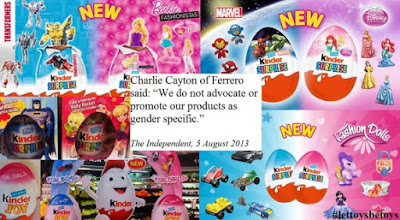
Kinder Joy and Hersheys are both chocolate producing companies in which, gender presentation can be visible. Both of them are targeted at different genders (a boy or a girl) as they associate the colours blue to boys and pink to girls. Hershey’s are targeted to the gender revelation of new born babies whereas Kinder Joy is targeted towards young children with toys categorizing and differentiating between the two genders. The car toys are listed under the title “for boys” whereas the female figurines, cute animals and pretty bracelets are labeled under “for girls”. Although Cayton of Ferrero said that “we do not advocate or promote our products as gender specific” in 2013, Kinder Joy continues to produce gender specified toys with their packaging clearly identifying and separating young children’s gender (for boys or for girls). They seem to “understand” what young girls and boys would prefer to play with and thus, splits the two genders with “gender appropriate” toys. Though...

'I Have a Dream' ~Martin Luther King, Kr.

The speech 'I have a dream' by Martin Luther Kind, Jr. persuades Negros to their freedom of racial justice in the American society. This was achieved with the use of inclusive language, rhetorical devices such as anaphoras, metaphors and diacope. To begin with, MLK speaks about American history where the Emancipation Proclamation was signed and thus, made millions of African Americans hopeful. The metaphor present here says "a great beacon of light of hope to millions of Negro slaves". This sentence provides a visual of the great significance the Proclamation held for Black Americans, and how much dependency was put onto it. Later on in his speech, he mentions how all hope was destroyed as the lifestyles of Negros declines, subsequently exposed to discrimination. The presence of anaphora "one hundred years later, the negro..." exemplifies the frustration of the Negros when their lives aren't getting any better. They're still outcasts and in pover...